*
East Asia Econ

East Asia Econ

The platform for tracking and understanding East Asia macro

China – still no sign of property momentum

China – still no sign of property momentum

After a clear improvement from September, property price deflation since December has settled at an annualised pace of around -1.5%. Sluggish mortgage lending isn't pointing to a further recovery from here. On these official data, average prices are now down 6% from the peak in 2021.

1 min read

China – no upside surprise in monetary data

China – no upside surprise in monetary data

Today's monetary data continue to suggest that the economy has bottomed, but don't point to a big recovery. Non-state and mortgage lending have stopped deteriorating, but don't show signs of the sort of recovery that would lift economic activity.

1 min read

China – inflation stuck

China – inflation stuck

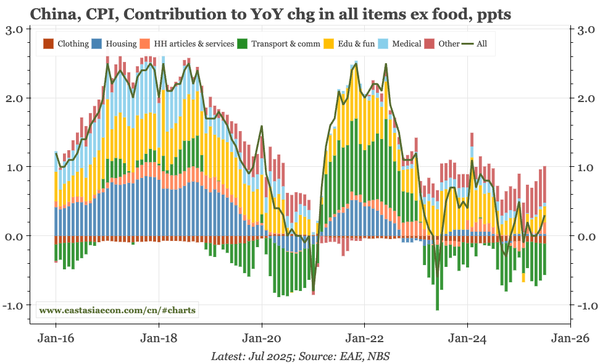
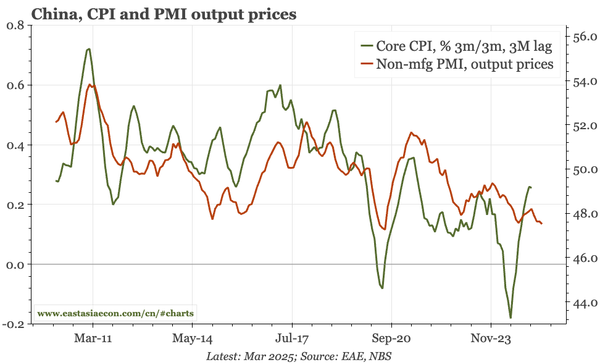
After the deflation of much of 2024, core sequential inflation has now been positive for six months. But it is now still only +0.2% annualised, and doesn't look to be going higher. Indicators for PPI suggest even more deflation ahead, with the one exception being the decline in the USD.

2 min read

China – US exports down, but ROW up

China – US exports down, but ROW up

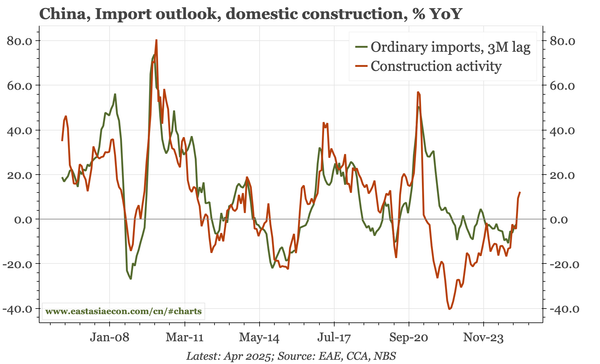
The expected fall in exports to the US did happen in April, but that was offset by stronger shipments to ROW. I wouldn't expect that to continue, but it is worth noting that today's data showed an increase in imports of components, which would usually indicate stronger exports in the next 3M.

2 min read

China – not so bad....yet

China – not so bad....yet

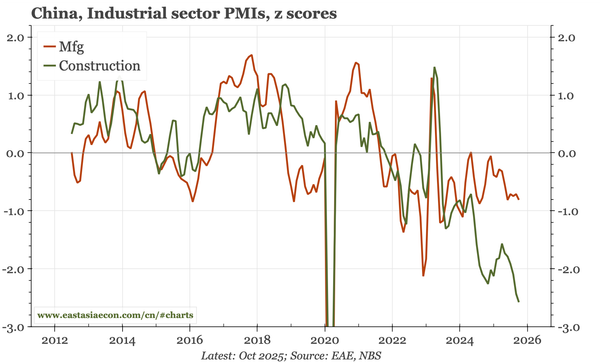
Export orders fell sharply in April, but the PMIs overall weren't so bad. One reason is a bottoming of the construction cycle. That, however, isn't improving, and with prices and the business outlook falling again, the economy still isn't on a stable footing to get through the tariff shock.

2 min read

China – corporate profitability still weak

China – corporate profitability still weak

Profits did rise YoY in March, but because of the base effect. Relative to GDP, earnings remain sluggish. Unsurprisingly, given the collapse of real estate, heavy industry is weakest. But in manufacturing, aggregate earnings aren't strong either, and around one-third of all firms are losing money.

2 min read

China – 5.4% isn't enough

China – 5.4% isn't enough

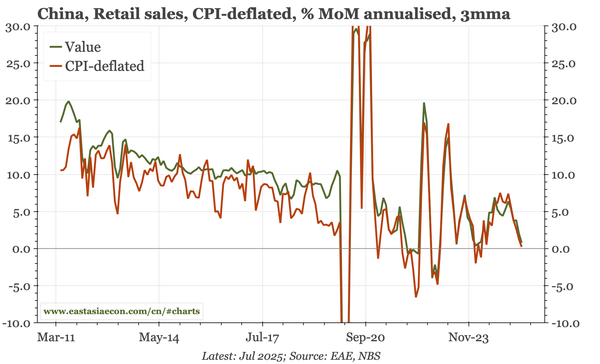
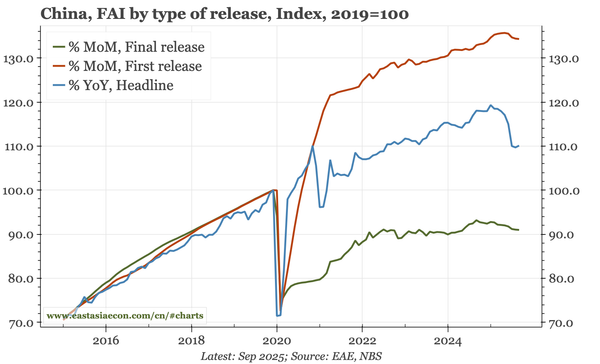
Since June last year, there has been a real inflection in retail sales and some construction indicators. In Q1, however, real estate remained as weak as ever. Manufacturing FAI is strong, but that has to be at risk from the trade war. Overall, the economy still isn't on a firm footing.

2 min read

China – policies to boost consumption

China – policies to boost consumption

The second of two videos on consumption, an issue that is even more important given the economic damage that will be inflicted on China by the tariffs. It is impossible to imagine Beijing supporting western-style consumerism. But there is still a way for economic policy to boost consumer spending.

1 min read

China – import ratio now the lowest since the 1990s

China – import ratio now the lowest since the 1990s

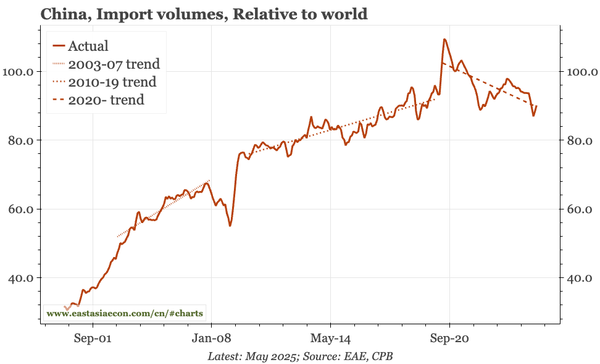
Exports through March were solid, but not so strong as to suggest big front-loading. The real standout is the import ratio dropping to a new post-1990s low. The trade surplus upsets Trump. Equally though, weak imports limit China's appeal as a market for others looking for an alternative to the US.

2 min read

China – recovery in credit growth continues

China – recovery in credit growth continues

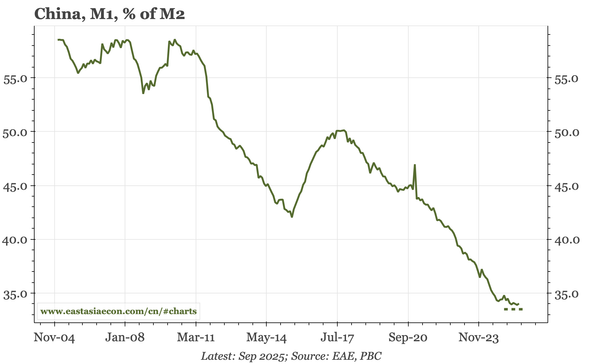
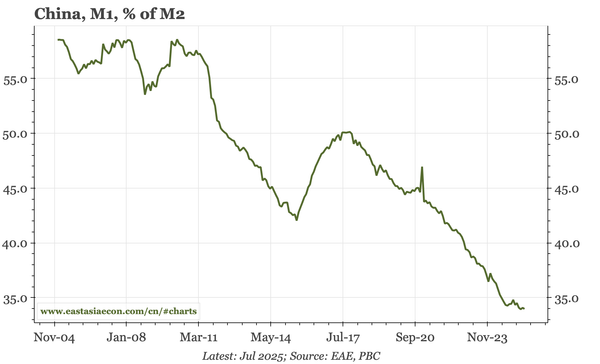
Credit and monetary data continue to suggest the monetary squeeze of 2023 and 1H24 has ended. The significance of the rebound is offset by three factors: it isn't incorporating non-government borrowing; mortgage lending isn't rising; and definitional changes to M1.

2 min read

China – stronger inflation not enough

China – stronger inflation not enough

The rise in core from Q424 sustained in Q125. But that isn't enough to suggest a turnaround in the GDP deflator, and Trump's tariffs mean that downside risks to inflation have grown again. Policy rates are likely to be cut, but that won't be enough to offset this latest shock.

2 min read

China – five consumption myths

China – five consumption myths

The first of two videos on consumption. This one looks at recent trends, arguing spending has been stronger than often realised. It still isn't high enough, especially given the huge shock from Trump's tariffs. So the second discusses policies that would boost consumption further.

1 min read

China – three post-tariff themes

China – three post-tariff themes

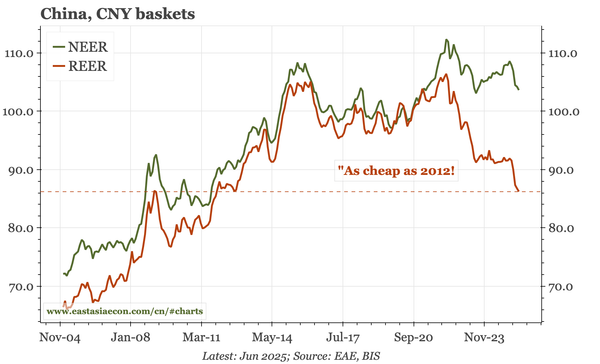
Yesterday's tariffs are close to a worse case scenario for China, and are a big negative shock when the cycle is already weak. Three things strike me as important in what happens next, both for China's economy, and for its global influence: consumption, imports, and the currency.

3 min read

China – muddling through at risk from tariffs

China – muddling through at risk from tariffs

The PMIs suggest the economy, once again, is muddling through. The better momentum after the policy announcements that started from September has faded, but isn't reversing. However, that probably isn't enough, given the new shock from tariffs that is about to hit.

2 min read

China – still difficult to get excited

China – still difficult to get excited

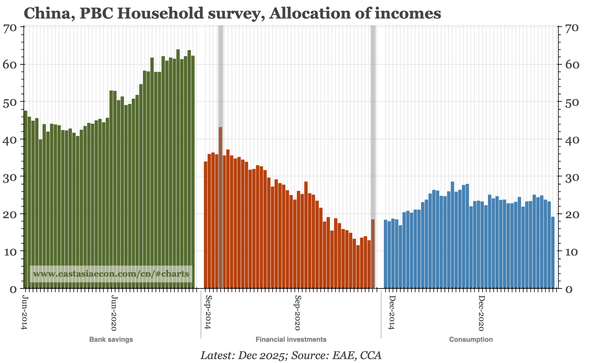
The PBC sentiment surveys suggest again an economy that is muddling through. One reason is that consumer spending hasn't fallen, with the big shifts instead being a further move away from consumption on goods to spending on services, and more saving in bank deposits rather than investments.

3 min read

China – Japanification scorecard: part 2

China – Japanification scorecard: part 2

A follow-up to the video a couple of weeks ago. That looked at demand-side factors. This delves into the supply-side and factors behind the "deflationary mindset". In these areas, China today looks even more different from Japan in the 1990s.

2 min read

China – overall, somewhat stable

China – overall, somewhat stable

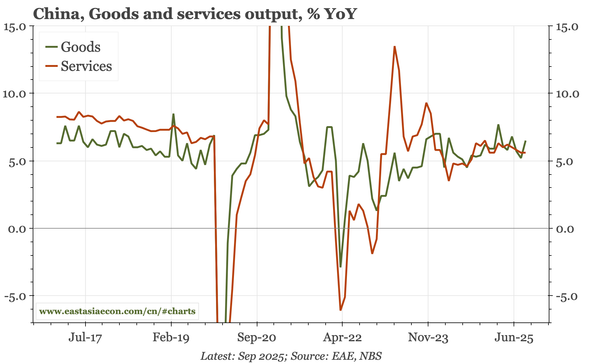
My view has been that China's cycle is probably stabilising, but not recovering. Today's data are consistent with that. Production of goods and services is running a bit over 5%, but property starts continue to fall, and retail sales don't point to any inflection in consumption

2 min read

China – a turn in the credit data

China – a turn in the credit data

The upturn in credit growth that began in June last year is continuing. That should be helping to put a floor under nominal growth. But that comes with caveats: private-sector credit lost momentum in February, and while mortgage lending isn't slowing, it doesn't show any sign of a rebound either.

1 min read

China – Japanification scorecard: part 1

China – Japanification scorecard: part 1

A video discussing why China isn't following Japan's path. This is the first part, looking at the seven demand-side factors that caused Japan's problems, and how China compares. The second video will discuss supply-side issues and the "deflationary mindset".

2 min read

China - PMI details suggest a floor

China - PMI details suggest a floor

The PMIs continue to suggest that, overall, there was no lasting improvement in the cycle after the September policy push. There are though some signs that things aren't getting worse any more, with both the construction PMI and employment indicators suggesting a floor.

2 min read

China – core CPI back up to +2%

China – core CPI back up to +2%

January core CPI picked up. That doesn't look like a Chinese New Year effect, and comes after Q4 when prices were already looking firmer. This dosn't mean inflation, but if core, which has underperformed other price indicators, is now catching up, it would mean China isn't in underlying deflation.

2 min read

China – on a Japanification scorecard, only getting 30%

China – on a Japanification scorecard, only getting 30%

With the BOJ's review of post-1990s Japan, we have an inventory for Japanification. Using this to assess China today, what stands out is not the similarities, but the differences. All told, on my scoring China isn't graduating to Japanification, achieving a mark of only 30%.

3 min read