Paul Cavey
Taiwan – another sign of shifting supply chains
Data today show Taiwan's export orders dipped in January, but that was likely because of the Lunar New Year. Our broader leading indicator shows export growth remaining around 10% YoY in the next few months. More interesting in today's data is the continued fall in the overseas production ratio.
Region – an illustration of Korea's export problems
This is a shorter thematic note than usual. In the longer piece last week, I didn't come up with a chart that nicely summarised Korea's export challenge. I think I have it now. While Korea is holding on in DM, it is losing market share just about everywhere else, being pushed out largely by China.
Korea – confidence up, prices down
Consumer confidence rose again in February but remains well below the LT average; moreover, the improvement is only being among younger people. At the same time, CPI and property price expectations softened. There will be more news tomorrow with business sentiment.
China – less property price deflation, but only just
Deflation eased in January, but only slightly. That's no surprise, given mortgage lending also remained weak last month. The sluggishness is persisting despite low rates, and the failure of rate cuts to revive the quintessentially rate sensitive sector remains a standout feature of this cycle.
Japan – solid services Tankan
Services sector sentiment in the Reuters Tankan remained elevated in today's February survey. Manufacturing is much weaker, and that remains something to be watching given the extra downside risk from tariffs. But in terms of Japan's cycle, Q1 is likely to be another decent quarter.
Korea – household deleveraging
Today's Q424 data show a continuation of the pick-up in household lending from the trough of early 2023. But at 2.4% saar compared with 8% before 2020, the rebound is mild, and slower than GDP growth. For an economy where most indicators have been deteriorating, that's one bit of good news.
Taiwan – upturn in wage growth holding
Like Japan, Taiwan had years of slowing wage and price inflation. And so, similarly with Japan, the turn in wage growth since the financial crisis is as much structural as cyclical. There's no sign of price inflation becoming problematic, but this wage picture suggests it isn't going back to zero.
China – credit mixed, and need more evidence of deposit turn
Gone are the days when the monetary data can make a big difference to the market mood. Today's release doesn't turn back the clock: the headline is a bit stronger, but mortgage lending wasn't, and there are distortions from Chinese New Year and definition changes.
Korea – employment improves, but only in the public sector
The rebound in headline employment in January wasn't broad, with jobs in the private sector remaining weak. With no reversal in the sharp rise in the participation rate of recent years, and the number of part-time jobs still rising, the labour market is likely less tight than headline data suggest.
China – real economy rates down again
Today's PBC data show another steep fall in mortgage interest rates in Q4. Rates are still 3%, so can go lower still. However, before 2020, real estate would be booming by now. That there's little reaction this time shows the problems in the real estate market won't be solved by rate cuts alone.
Region – export trends and market implications
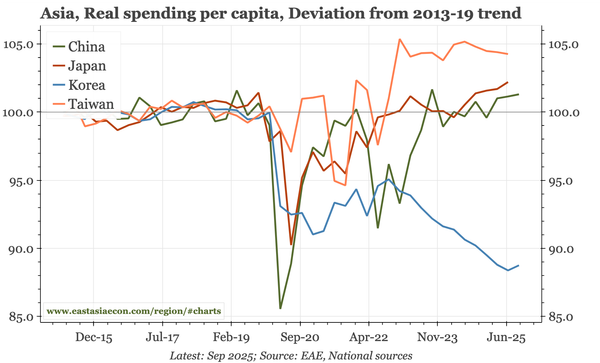
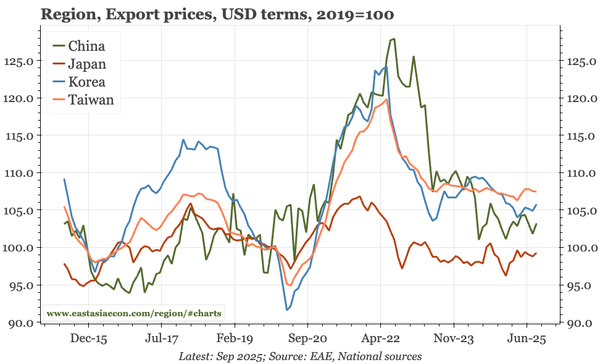
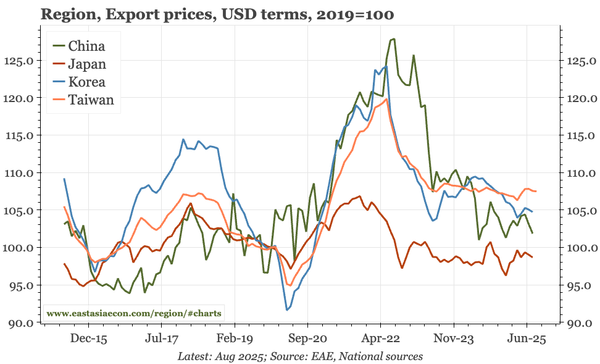
In LCU terms, there's little to choose between exports in the different economies. But in volumes, China and Taiwan are very strong, and Korea and Japan clearly lagging. This should have implications for CNY, TWD and KRW. For Japan, the significance is for macro if USDJPY turns.
Japan – not simply import prices
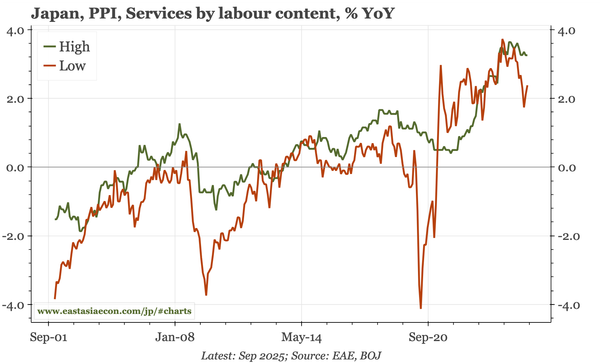
Import price inflation did rise in January, but PPI inflation was much higher, and the relationship between the two has clearly weakened. One driver is the cutting back of gasoline price subsidies, a policy that had held back PPI even as import prices surged in 2021-22.
Korea – exports still slowing
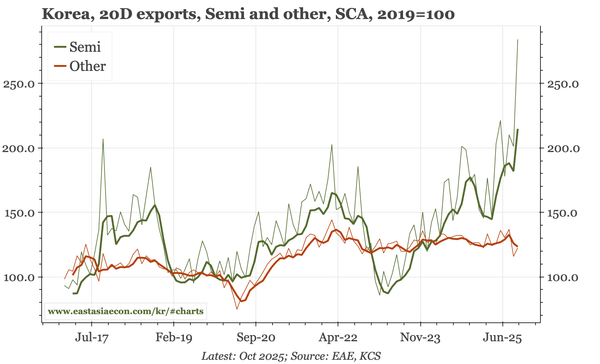
10-day data are never the most robust indicator, and particularly in February given the January holidays. Still, it is notable that there's no turnaround in the export slowdown that began in Q4. Indeed, adjusting for working days, exports have fallen this month for the first time since late 2023.
Region – Asia's dramatic demographics
A longer video discussing demographics, the area where Asia is most clearly leading the world. The changes in the population will clearly matter for economies, but Japan's experience shows the macro implications aren't necessarily what might be expected.
Japan – EW suggests stable growth
There's plenty of evidence that in nominal terms, the economy is growing strongly. After adjusting for prices, however, growth in real terms isn't nearly so impressive. The Economy Watchers survey today suggests RGDP is expanding, but no more quickly than it was before 2020.
China – core CPI back up to +2%
January core CPI picked up. That doesn't look like a Chinese New Year effect, and comes after Q4 when prices were already looking firmer. This dosn't mean inflation, but if core, which has underperformed other price indicators, is now catching up, it would mean China isn't in underlying deflation.
Taiwan – LNY explains higher CPI, but not stronger exports
The spike in inflation seen in January isn't unexpected given consumer spending on the back of this year's early Chinese New Year. The strength of exports can't be explained away in the same way, and suggests Taiwan's relative outperformance is continuing.
Japan – the hawkish case
Naoki Tamura is a relative hawk at the BOJ. While that doesn't make him mainstream, his speech today is still worth reading, because it is direct and well-reasoned, and because an upside surprise in inflation and rates is a very reasonable scenario for 2025.
Japan -part-time wage growth at 4.6%
Full-time worker wage growth remains stable at a bit under 3%. Further acceleration is likely, though not much: this year's shunto will probably moderate from 2024. Part-time worker wage growth is though continuing to rise, consistent with the BOJ's view of a tight labour market.
Korea – core inflation up again, but growth fears dominate
Data today show the rise in underlying inflation that has been underway for almost a year continuing. But yesterday's minutes of the last BOK meeting show that notwithstanding the rise in $KRW, weak growth rather than rising inflation remains the much bigger concern.