*
Paul Cavey

Paul Cavey

East Asia Today

East Asia Today

Today's data show another surge in overseas equity buying in Korea, consumption in Japan that is quite strong considering the headwinds of population decline and real income squeeze, and inflation in Taiwan which has now fallen to 1.2%, but I don't expect will drop much further.

3 min read

Korea – more huge overseas equity buying

Korea – more huge overseas equity buying

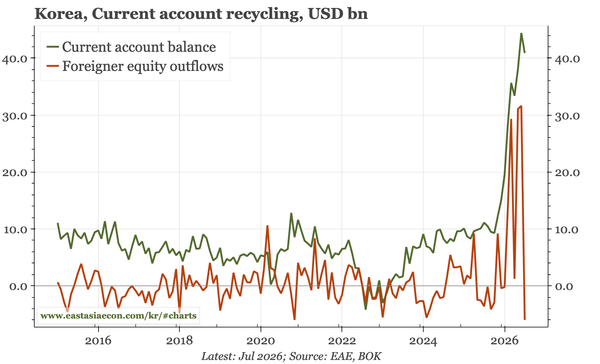
The big shift in Korea's BOP since 2020 has been the rise in overseas buying of equities. That outflow surged anew in October to a record high, and by offsetting the large current account surplus, has helped keep $KRW near record highs.

2 min read

East Asia Today

East Asia Today

In advance of next week's release of CPI and PPI data in China, some thoughts on the outlook, which I think shows a lessening deflation. Also, an update on visitor arrivals in the region (strong in Japan, weak in Taiwan), and weekly flow data in Japan.

2 min read

China – lessening deflation

China – lessening deflation

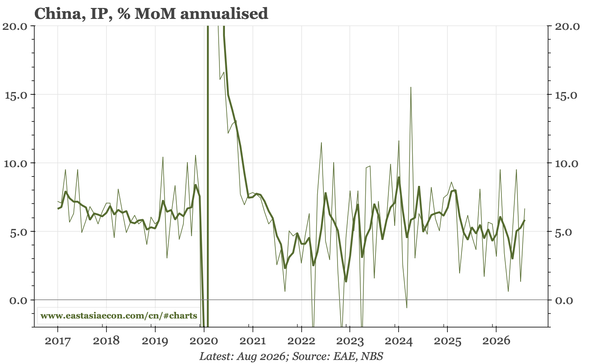
High-frequency data show upstream prices remained stable in November, while food prices have been rising. The combination points to a further lessening of headline deflation. I doubt that signals a real turn in nominal growth, though there are now some upside risks.

2 min read

East Asia Today

East Asia Today

China's November S&P services PMI didn't confirm the weakness seen in the official version. S&P today also released its services PMI for Japan. That sent the same message as other sentiment surveys: far from weakening, economic momentum in Japan is improving. Also today, my latest video and podcast.

2 min read

East Asia Today

East Asia Today

Japan's consumers like what they are seeing of Sanae Takaichi, with another bounce in confidence in November. That removes another reason for BOJ caution. In Korea, inflation remains at around 2%, but services inflation – a better measure of domestically generated price pressures – is higher.

2 min read

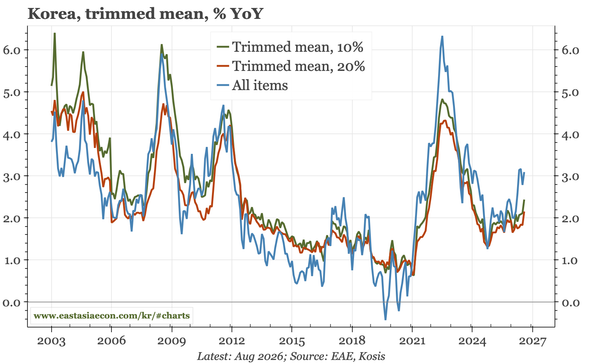
Korea – core inflation stable, but not low

Korea  – core inflation stable, but not low

The BOK says the rise in headline CPI inflation to 2.4% the last couple of months is temporary, and that core is stable. That isn't an unreasonable assessment. However, I'd continue to highlight the strength of services inflation, which remains firm reltive to ongoing labour market weakness.

2 min read

East Asia Today

East Asia Today

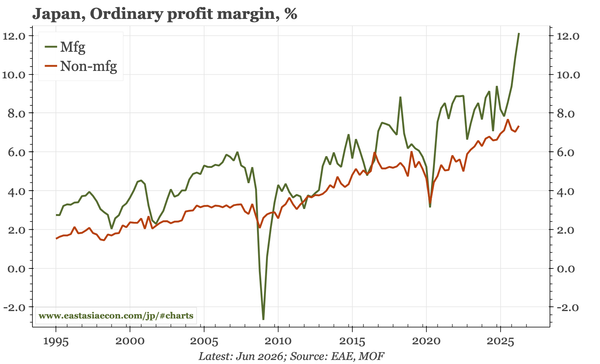
The big policy event today was BOJ Governor Ueda's speech, which further increased the likelihood of a near-term hike. In terms of data, Japan released quarterly profits data (strong in non-manufacturing) and weak PMIs for the region contrasted with strong semiconductor export data for Korea.

2 min read

Region – manufacturing PMIs and Korean exports

Region – manufacturing PMIs and Korean exports

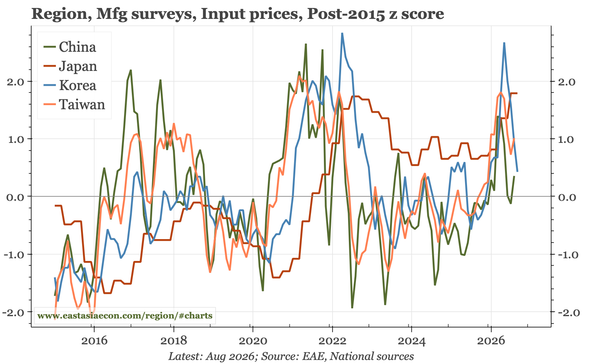
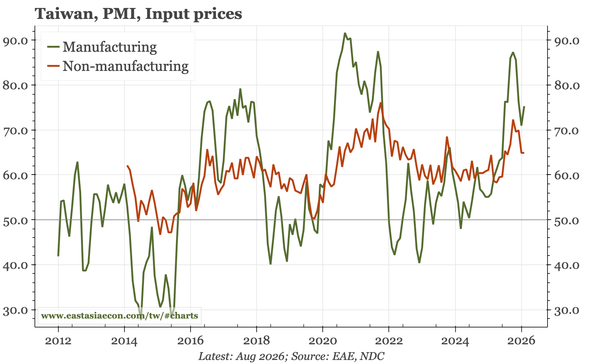
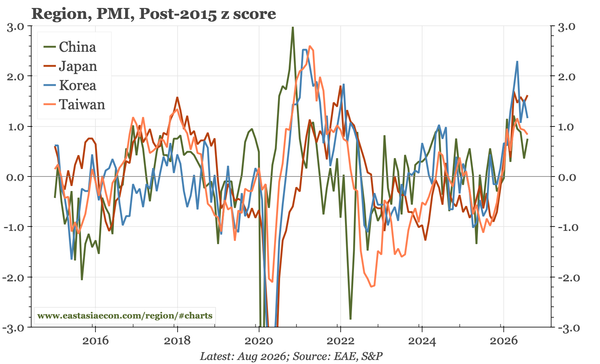
The mfg PMIs across the region mainly remain below 50. That shows that conditions outside of semiconductors remain poor. Semi is strong, and in Korean in export data for November, are departing from a normal cycle. Goods input prices pressures are rebounding, reflecting weak currencies.

3 min read

Japan – Ueda becomes constructive again

Japan – Ueda becomes constructive again

The tone of governor Ueda's speech today suggests a rate hike is close. He claims that risks to the US are receding, identifies five recent positive wage developments, and with firms' price and wage behaviour changing, argues that exchange rate changes are more likely to affect prices.

5 min read

Last week, next week

Last week, next week

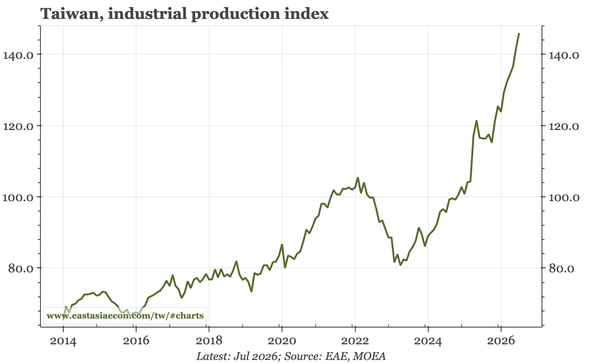
The main themes: stabilisation in China, but the picture is muddy; the discrepancy between clear economic boom in Taiwan versus stability in inflation and TWD; upside risks in Korea that still look like risks than reality; the BOJ facing a real fiscal boost when the economy is already recovering.

7 min read

China – more data puzzles

China – more data puzzles

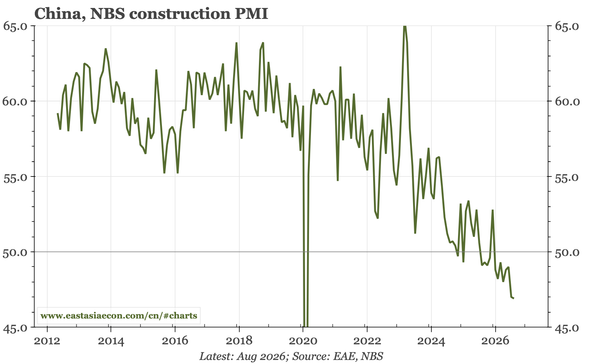
The official composite output PMI in November fell below 50. That wasn't because of FAI: the industrial PMIs were stable. Rather, it was weakness in services. That is puzzling. For now, the one concrete indicator from today's inflation is actually positive: deflation isn't getting worse.

3 min read

East Asia Today

East Asia Today

Today's charts cover October services trade and the implications for China's GDP growth in Q4; Tokyo inflation (showing stronger rents), and retail sales in Japan; weak October activity in Korea; and yet another round of strong GDP data in Taiwan.

3 min read

Taiwan – everything revised up, except inflation

Taiwan – everything revised up, except inflation

In today's GDP release, the government raised estimated growth for Q1, Q2, and Q3. The FY forecast was raised by almost 3ppts to 7.4%. But because of AI, officials remain bullish about the outlook, and so raised the forecast for 2026 as well, And yet, none of this is expected to impact inflation.

3 min read

Korea – still no clear lift in growth

Korea – still no clear lift in growth

The BOK's revisions to the GDP outlook yesterday were modest. But in today's October output data, there's little sign of any improvement at all. The data are affected by the long Chuseok holiday, and will likely look better through year-end. Still, it is clear the economy still faces headwinds.

2 min read

East Asia Today

East Asia Today

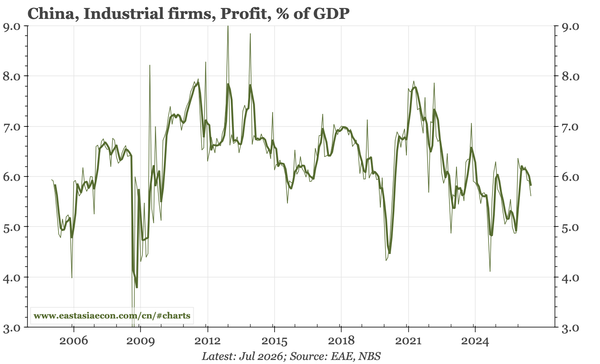
The big event today was the BOK meeting. The bank was a bit more constructive on the outlook, but data that was separately released show labour market conditions remaining weak. Elsewhere, profits in China are flat-lining, exports in Japan aren't dropping, and macro data in Taiwan remain strong.

3 min read

Korea – was when, now also whether

Korea – was when, now also whether

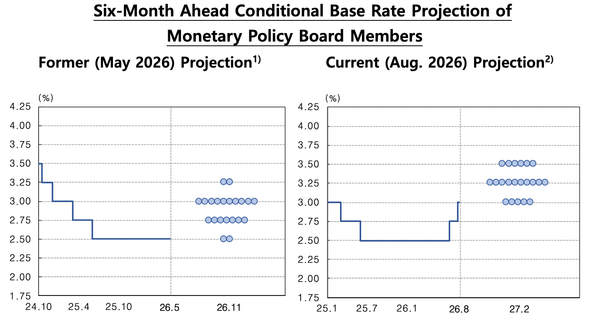
The BOK didn't raise growth forecasts above potential, but still signalled some concern about the resilience of inflation. That sounds a touch stagflationary, and was used to justify a step back from its loosening stance. Growth only gets above potential in its chip-driven upside scenario.

3 min read

East Asia Today

East Asia Today

Some thoughts on Korea in light of today's business sentiment survey, and before tomorrow's BOK meeting. Also, today's services PPI inflation for Japan. The details were mixed, but the BOJ anyway seems to be sending the message (again) that while the JPY is so weak, it is headline CPI that matters.

2 min read

Japan – SPPI inflation soft in October

Japan – SPPI inflation soft in October

Headline SPPI inflation was stable in October, but weak for high labour-intensive sectors, while part-time wages were strong, likely on the back of the minimum wage hike. That's an unclear picture. But right now, with the JPY so weak, the BOJ will focus more on headline CPI than these messy details.

3 min read

East Asia Today

East Asia Today

Both consumer sentiment and house price expectations in Korea were firm in November. That's significant, when consumer fiscal handouts are winding down, while macro-pru measures on housing have been stepped up. In Taiwan, the consumer mood is also improving, with retail sales rising in October.

2 min read

East Asia Today

East Asia Today

That high-frequency upstream prices in China through mid-November are stable offers an important contrast with the weakness of FAI. In Taiwan, the labour market remains tight, with the unemployment rate staying at the lowest levels in over 20 years.

2 min read

China – prices and demand deposits stable

China – prices and demand deposits stable

The FAI data point to the economy hitting a wall. But price data don't bear that out. Indeed, upstream prices show the recent stability of PPI is likely persisting. That is also true for the demand:time deposit ratio. The cycle as a whole remains both weak and messy, but there are some green shoots.

2 min read

Last week, next week

Last week, next week

Japan is doing macro stimulus when the cycle really doesn't need it. China isn't doing any when the cycle still does. The first keeps the JPY weak. The second prevents the CNY from appreciating. Both in turn weigh on the KRW and TWD, despite substantial current account surpluses across the region.

6 min read